
13,00€
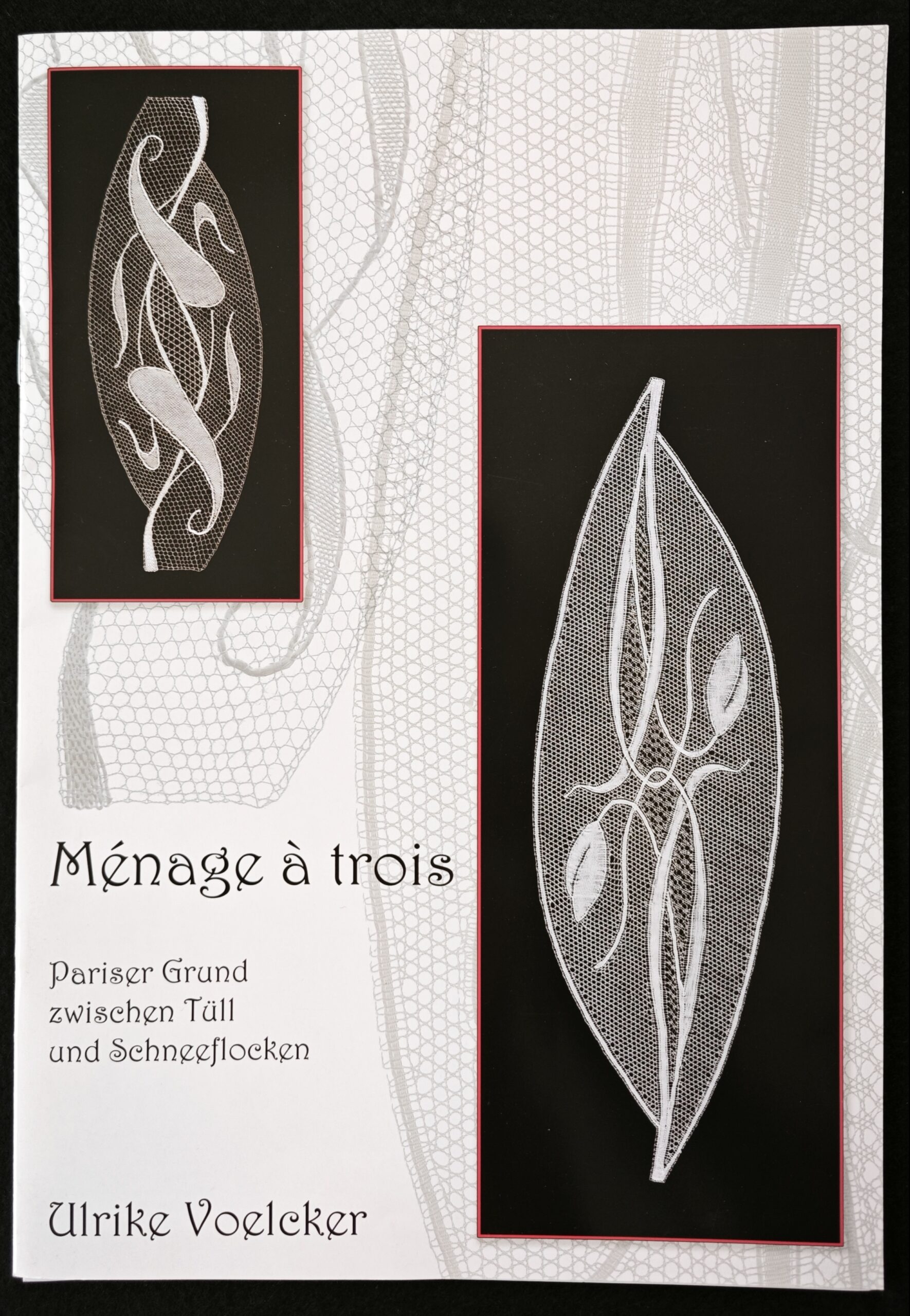
Cette année, Ulrike Voelcker s’est également intéressée à la dentelle de Paris.
Elle nous propose dix modèles de cette dentelle encore peu connue dans un format dépliant comprenant des cartons (picots), des diagrammes, des photographies et des explications.
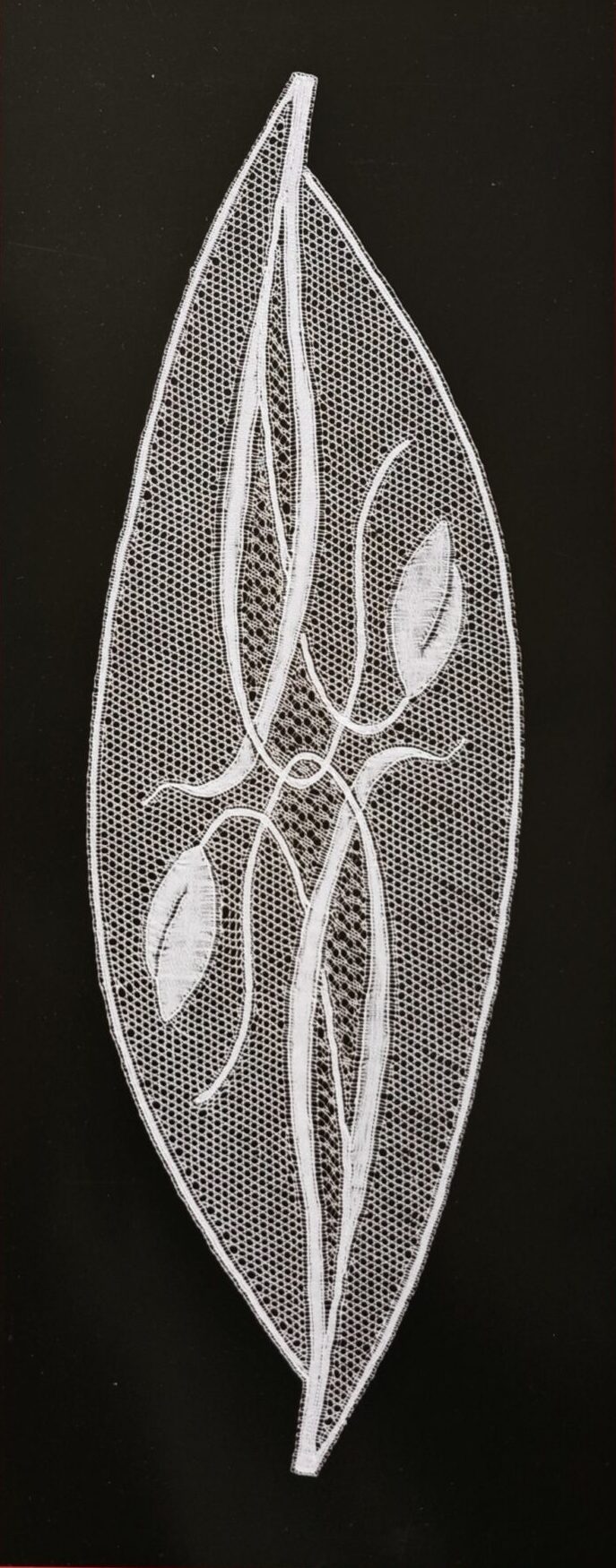
La dentelle de Paris se distingue par son fond hexagonal traversé par un fil horizontal formant des mailles triangulaires. Les motifs sont entourés d’un cordon et se composent généralement de fleurs, de feuilles, de roses et de trèfles qui se détachent sur un réseau orné de petites perles. On peut également souligner la délicatesse et la finesse de ses fils, l’harmonie de ses motifs ornementaux ainsi que son fond spécifique réalisé avec trois paires à chaque croisement. Traditionnellement, elle se caractérise par des motifs floraux, des feuilles stylisées, de petits réseaux et des éléments géométriques qui se combinent pour former des compositions équilibrées et légères. Dans ce travail, Ulrike Voelcker présente des créations modernes de sa propre conception, réalisées avec cette technique encore peu travaillée par les dentellières.
Le format dépliant permet de présenter plusieurs pièces de manière continue, créant une petite galerie textile qui invite à observer chaque modèle avec attention. En l’ouvrant, le lecteur découvre une série de dix modèles différents qui illustrent la variété des motifs, des densités et des compositions caractéristiques de la dentelle de Paris.
Au-delà de sa valeur esthétique, ce dépliant constitue également une source d’inspiration et d’apprentissage pour celles et ceux qui s’intéressent à la dentelle, en particulier à la dentelle aux fuseaux. Chaque modèle peut servir de référence pour étudier la composition, comprendre la relation entre les éléments ornementaux et observer l’équilibre entre les pleins et les vides.
Dans son ensemble, ce dépliant ne rassemble pas seulement dix exemples de dentelle de Paris, mais propose aussi une petite exploration visuelle de son style. À travers la comparaison des modèles, l’observateur peut apprécier la diversité créative qui existe au sein d’une même tradition textile, où la précision technique se combine avec la grande sensibilité artistique de l’autrice, Ulrike Voelcker.
Partagez avec vos proches
Arzhela Bolillos Déclaration d'accessibilité
We firmly believe that the internet should be available and accessible to anyone, and are committed to providing a website that is accessible to the widest possible audience, regardless of circumstance and ability.
To fulfill this, we aim to adhere as strictly as possible to the World Wide Web Consortium’s (W3C) Web Content Accessibility Guidelines 2.1 (WCAG 2.1) at the AA level. These guidelines explain how to make web content accessible to people with a wide array of disabilities. Complying with those guidelines helps us ensure that the website is accessible to all people: blind people, people with motor impairments, visual impairment, cognitive disabilities, and more.
This website utilizes various technologies that are meant to make it as accessible as possible at all times. We utilize an accessibility interface that allows persons with specific disabilities to adjust the website’s UI (user interface) and design it to their personal needs.
Additionally, the website utilizes an AI-based application that runs in the background and optimizes its accessibility level constantly. This application remediates the website’s HTML, adapts Its functionality and behavior for screen-readers used by the blind users, and for keyboard functions used by individuals with motor impairments.
If you’ve found a malfunction or have ideas for improvement, we’ll be happy to hear from you. You can reach out to the website’s operators by using the following email
Our website implements the ARIA attributes (Accessible Rich Internet Applications) technique, alongside various different behavioral changes, to ensure blind users visiting with screen-readers are able to read, comprehend, and enjoy the website’s functions. As soon as a user with a screen-reader enters your site, they immediately receive a prompt to enter the Screen-Reader Profile so they can browse and operate your site effectively. Here’s how our website covers some of the most important screen-reader requirements, alongside console screenshots of code examples:
Screen-reader optimization: we run a background process that learns the website’s components from top to bottom, to ensure ongoing compliance even when updating the website. In this process, we provide screen-readers with meaningful data using the ARIA set of attributes. For example, we provide accurate form labels; descriptions for actionable icons (social media icons, search icons, cart icons, etc.); validation guidance for form inputs; element roles such as buttons, menus, modal dialogues (popups), and others. Additionally, the background process scans all of the website’s images and provides an accurate and meaningful image-object-recognition-based description as an ALT (alternate text) tag for images that are not described. It will also extract texts that are embedded within the image, using an OCR (optical character recognition) technology. To turn on screen-reader adjustments at any time, users need only to press the Alt+1 keyboard combination. Screen-reader users also get automatic announcements to turn the Screen-reader mode on as soon as they enter the website.
These adjustments are compatible with all popular screen readers, including JAWS and NVDA.
Keyboard navigation optimization: The background process also adjusts the website’s HTML, and adds various behaviors using JavaScript code to make the website operable by the keyboard. This includes the ability to navigate the website using the Tab and Shift+Tab keys, operate dropdowns with the arrow keys, close them with Esc, trigger buttons and links using the Enter key, navigate between radio and checkbox elements using the arrow keys, and fill them in with the Spacebar or Enter key.Additionally, keyboard users will find quick-navigation and content-skip menus, available at any time by clicking Alt+1, or as the first elements of the site while navigating with the keyboard. The background process also handles triggered popups by moving the keyboard focus towards them as soon as they appear, and not allow the focus drift outside of it.
Users can also use shortcuts such as “M” (menus), “H” (headings), “F” (forms), “B” (buttons), and “G” (graphics) to jump to specific elements.
We aim to support the widest array of browsers and assistive technologies as possible, so our users can choose the best fitting tools for them, with as few limitations as possible. Therefore, we have worked very hard to be able to support all major systems that comprise over 95% of the user market share including Google Chrome, Mozilla Firefox, Apple Safari, Opera and Microsoft Edge, JAWS and NVDA (screen readers), both for Windows and for MAC users.
Despite our very best efforts to allow anybody to adjust the website to their needs, there may still be pages or sections that are not fully accessible, are in the process of becoming accessible, or are lacking an adequate technological solution to make them accessible. Still, we are continually improving our accessibility, adding, updating and improving its options and features, and developing and adopting new technologies. All this is meant to reach the optimal level of accessibility, following technological advancements. For any assistance, please reach out to